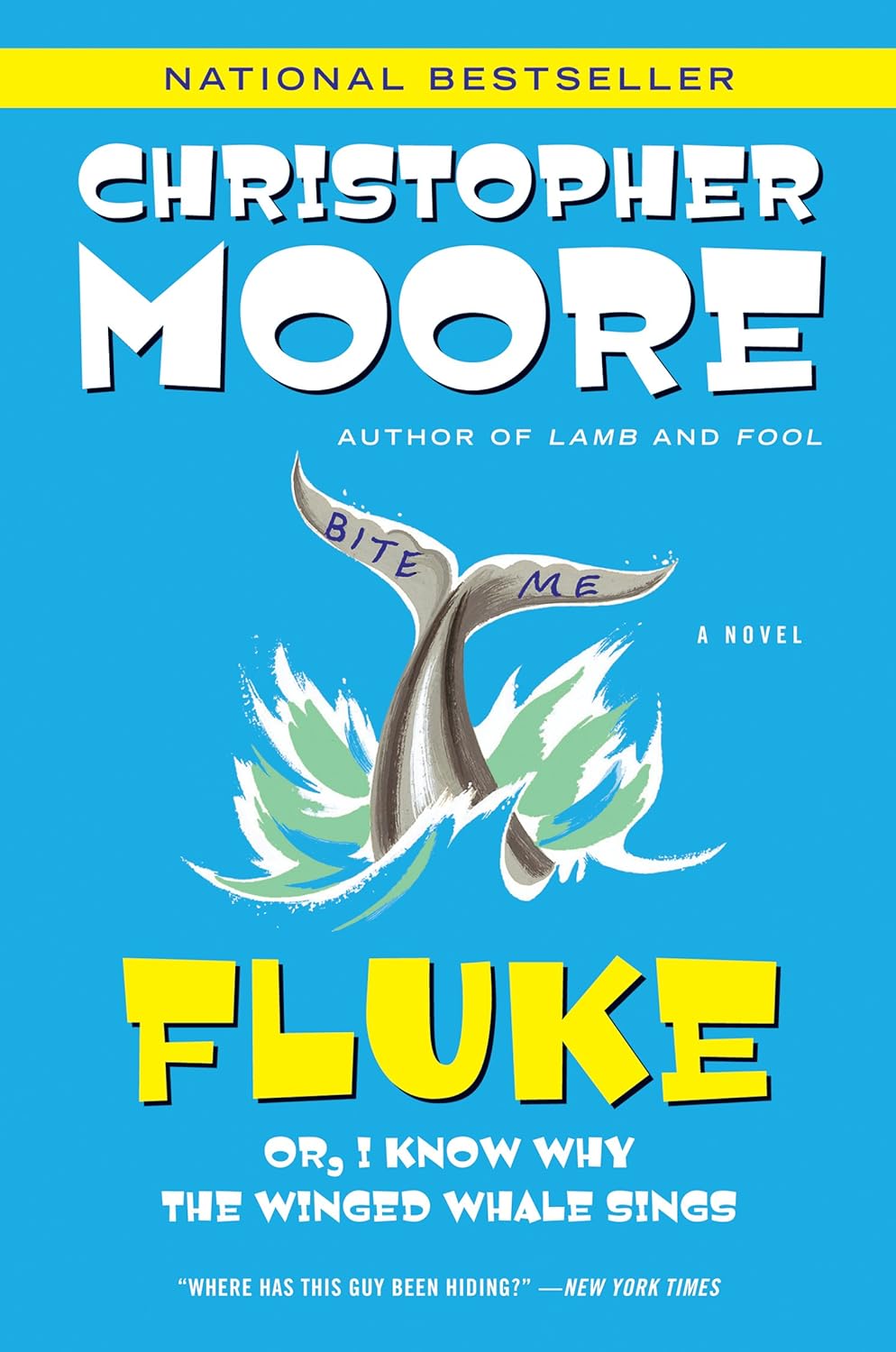
Fluke
Just why do humpback whales sing? Thats the question that has marine behavioral biologist Nate Quinn and his crew poking, charting, recording, and photographing very big, wet, gray marine mammals. Until the extraordinary day when a whale lifts its tail into the air to display a cryptic message spelled out in foot-high letters: Bite me.
Trouble is, Nate’s beginning to wonder if he hasn’t spent just a little too much time in the sun. Cause no one else on his team saw a thing — not his longtime partner, Clay Demodocus; not their saucy young research assistant; not even the spliff-puffing white-boy Rastaman Kona (né Preston Applebaum). But later, when a roll of film returns from the lab missing the crucial tail shot — and his research facility is trashed — Nate realizes something very fishy indeed is going on.
By turns witty, irreverent, fascinating, puzzling, and surprising, Fluke is Christopher Moore at his outrageous best.
“[H]ilarious, educational, and original. . . . [I]t is difficult to put the book down, for there are astonishing new developments on every page.”
— BookPage
“[I]f you ever wondered what happened to Amelia Earheart or all those folks lost in the Bermuda Triangle; if you ever wonder about the nature of God; if you wonder ‘why the winged whale sings’; if you want to experience the greatest satirist since Jonathan Swift — you just have to read FLUKE.”
— Denver Rocky Mountain News
“[In his] outrageous new novel … Moore is endlessly inventive … this cetacean picaresque is no fluke — it is a sure winner.”
— Publishers Weekly (starred review)
“[O]ne of finest pieces of imagination since Anatole France’s Penguin Island, or George Orwell’s Animal Farm.”
— Denver Post
“A great time for the reader. A great idea, and a funny story. . . . Go out and buy this book.”
— USA Today
“An enchanting, audacious eco-fantasy . . . Jacques Cousteau by way of Douglas Adams, liberally spiced with dialogue that would make Elmore Leonard proud, and a whimsical sense of the absurd not seen since Tom Robbins’s early heyday.”
— Toronto Globe and Mail
“FLUKE is a lighthearted book that still manages to make some serious points about the human condition. . . . [Moore’s] imagination is a gift to the reader.”
— Baltimore Sun
“Moore’s career has plainly been one of scaling new peaks; with the current book [Fluke] he might just have outdone himself . . . If the ghost of Jules Verne had conspired with Rudy Rucker and Tom Robbins to produce a novel, Fluke might very well make them hang their heads in defeat. . . .This novel is all ambergris, no blubber.”
— Washington Post Book World
“Readers new to the work of Christopher Moore will want to know . . . where has this guy been hiding? (Answer: In plain sight, since he has a devoted cult following.) . . . [H]e writes laid-back fables straight out of Margaritaville, on the cusp of humor and science fiction.”
— Janet Maslin, The New York Times
“Wonderfully strange and fall-down funny as always, Moore delivers, with moxie and wit, a satisfying collage of science, magic, comedy, fantasy and Save-the-Whale propaganda. . . . Tempered with Seussian logic, the pure and innocent wonder of a child’s anything-is-possible imagination and the devilishly funny voice.
— San Diego Union-Tribune
“You’re not likely to stumble across another book like [FLUKE] . . . and it contains more than its fair share of goofy fun . . . definitely the perfect book for a day at the beach.”
— San Francisco Chronicle Book Review
Reading Guide for Fluke
Introduction
Biologist Nate Quinn is obsessed with one question: Why do humpback whales sing? All his research in the waters off Maui revolves around his quest to find the answer. He's got help: His loyal partner, photographer Clay Demodocus; his attractive new research assistant, Amy Earhart; Kona, a wanna-be Rastafarian with a knack for intuitive leaps of scientific thinking (even while stoned); a dotty old benefactress; and a ragtag cast of deep-sea divers, fellow scientists, an ex-wife and her girlfriend.
Everything’s going swimmingly for Quinn until he spots the strangest thing. Is he losing it, or did he see the words “Bite Me” on a whales tail? He snaps a picture, but when the film comes back the crucial frame is missing. Quinn gets even more confused when his benefactress, Elizabeth, tells him she got a phone call from a whale, who’d like a hot pastrami and Swiss on rye. Huh?
One afternoon, while trying again to get the “Bite Me” on film, Quinn is swallowed by the “Bite Me” whale, which isn’t really a whale at all, but a whale-like ship piloted by humanoid whale-creature (whaley boys) and occupied by thousands of other humans.
While his friends mourn his death, Quinn is spirited from one whale ship to another, and finally to “Gooville,” where much is revealed to Quinn. Inextricably imbedded in the science he's so doggedly pursued his whole career, Quinn finds magic. Eventually, he returns to life on top of the sea, instead of beneath it, but nothing ever looks quite the same again.
Topics for Discussion
- Is the thrill of discovery what motivates scientists to stick to their work, day after day?
- Sexuality is a prominent theme in the book. Did you find the sexuality of the whaley boys offensive? Funny? Do you think its a commentary on traditional human sexual mores?
- The author has a very distinct writing style, especially when it comes to dialogue and his characters tendency for flip banter, even in the midst of serious conversations and situations. Do you find this treatment distracting, or humorous?
- Did this book make you think? What are some of the questions it raised for you?
- Did this book make you laugh? Is the authors unique sense of humor one that you can appreciate? Do you like Moore’s writing style?
- Do you think Moore is delivering an effective message about conservation? Has this book inspired you to change your actions? Or was a concern for the environment one of the things that drew you to the book in the first place?
- What do you know about male-female roles in other animal populations? Are human gender roles in line with those of our fellow creatures? And are societal changes in the last several decades something we can attribute to evolution?
Author's Notes from Fluke
What do most people know about whales beyond that fact that they’re big and wet? Not much, right? Well, having been a scuba diver for a long time, and lived next to the ocean for some twenty-five years, I thought, I really should learn more about these big wet things that keep swimming by. So I started learning about whales, and more important, the people whose business it is to learn about whales.
Something happens when you spend any amount of time on the ocean with people who have a less than conservative view of how one should make his living: you begin to feel that adventure is its own reward. You begin to measure experience, rather than sustenance, as the goal; and you begin to get a feeling for those adventurers you left behind in your childhood: those salty rapscallions sprung from the imaginations of Jack London and Jules Verne and Robert Louis Stevenson — even the twisted eccentrics of Joseph Conrad and the ancient undersea beings of H.P. Lovecraft. (And you begin, too, to wish you’d brought along some Dramamine.) As a writer, you get it, the same way that you got it when you were a kid, and theres not much you can do but share the adventures.
So I got it, and I’m passing it on to you, that “fear recalled in comfort” that is called the adventure story.
Have fun.
Sincerely,
Christopher Moore