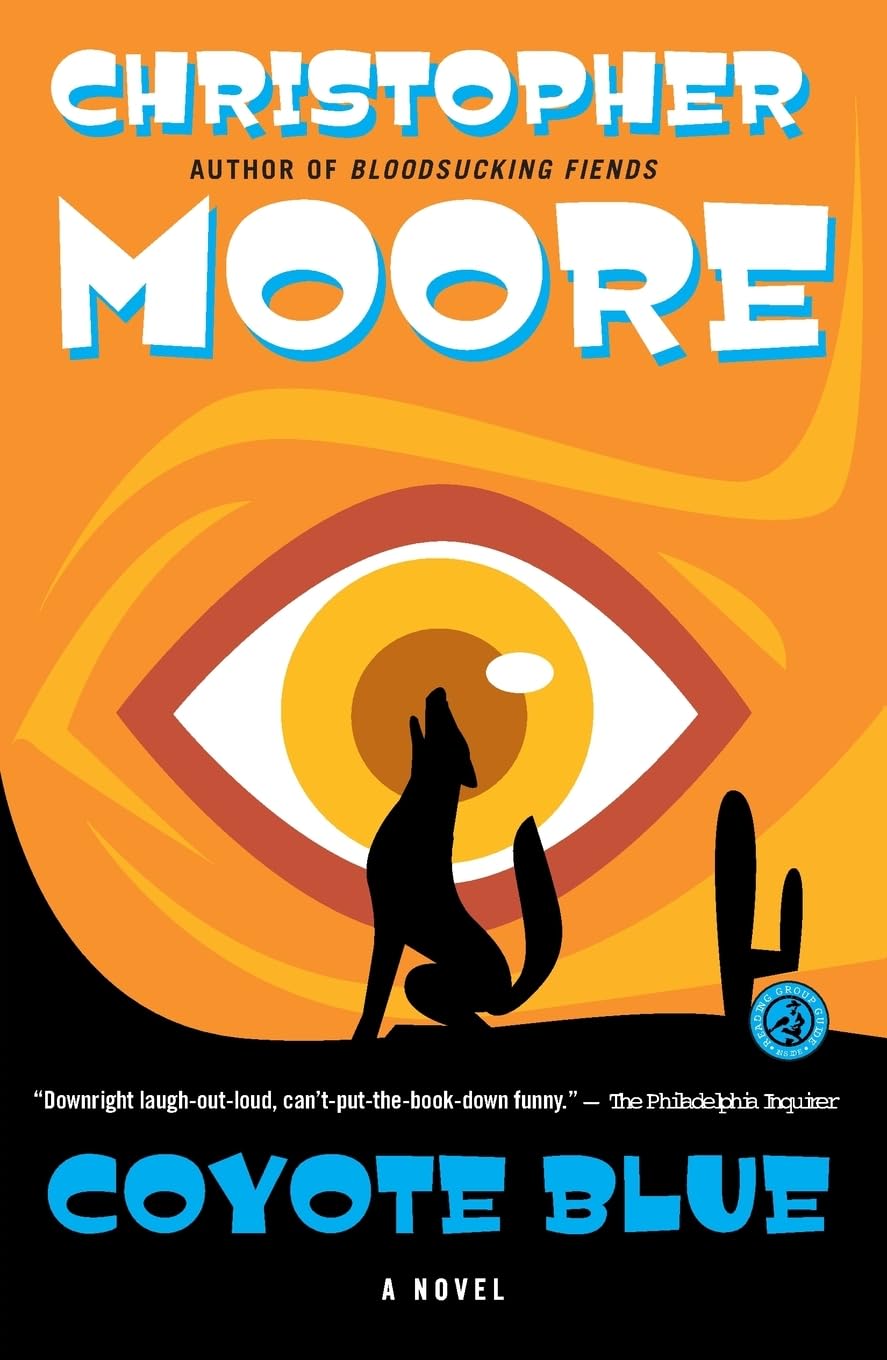
Coyote Blue
From Christopher Moore, author of Fluke, comes a quirky, irreverent novel of love, myth, metaphysics, outlaw biking, angst, and outrageous redemption.
As a boy growing up in Montana, he was Samson Hunts Alone — until a deadly misunderstanding with the law forced him to flee the Crow reservation at age fifteen. Today he is Samuel Hunter, a successful Santa Barbara insurance salesman with a Mercedes, a condo, and a hollow, invented life. Then one day, shortly after his thirty-fifth birthday, destiny offers him the dangerous gift of love — in the exquisite form of Calliope Kincaid — and a curse in the unheralded appearance of an ancient Indian god by the name of Coyote. Coyote, the trickster, has arrived to transform tranquility into chaos, to reawaken the mystical storyteller within Sam . . . and to seriously screw up his existence in the process.
Reading Guide for Coyote Blue
Introduction
As a boy growing up in Montana, he was Samson Hunts Alone — until a deadly misunderstanding with the law forced him to flee the Crow reservation at age fifteen. Today he is a successful Santa Barbara insurance salesman with a Mercedes, a condo, and a hollow, invented life.
Then one day, shortly after his 35th birthday, destiny offers Samuel Hunter the dangerous gift of love in the exquisite form of Calliope Kincaid — and a curse in the unheralded appearance of an ancient Indian god by the name of Coyote. Coyote, the trickster, has arrived to transform tranquility into chaos, to reawaken the mystical storyteller within Sam … and to seriously screw up his existence in the process.
Topics for Discussion
- Sam Hunter is described as a “machine,” becoming whomever he needs to be to make the deal. He has put on so many faces that he has lost sight of who he really is. Do you know anyone like this? Do people really lose themselves in the roles they play?
Coyote is the trickster of many Native American tribes, a god who, it seems, exists merely to cause trouble. There are trickster figures in almost every culture in the world. Why do you think this is? - The author describes Sams sale of insurance not as “scare tactics” but as playing on peoples innate fear of irony (that is: if you let your insurance lapse, you are sure to wreck your car). Is there any basis in this belief? Have you ever made a decision based on the fear of irony? Is irony a real force in the universe?
- Calliope describes herself as almost a victim of her own beauty. Are attractive women trivialized because of their looks? Do you generally assume that a beautiful woman is less intelligent? What about a handsome man? Does our society create “airheads” by having lower expectations for the accomplishments of pretty young girls?
- At the end of the book, Coyote states that he has come back to make new stories for his people. What does this say about preserving cultures and religions that dont seem to relate well to the changes in our modern world? Would the Bible or the Koran tell different stories if there were telephones, computers, and other modern technologies available at the time? Can traditional beliefs survive in the face of the increasing pace of change in our lives?
Author's Notes from Coyote Blue
Do you ever get the feeling that forces unseen are messing with your life? Yeah, me too. And theres little doubt that those forces are driven by the greatest force in the universe — irony, right? Right?
So imagine my surprise when, some years ago, while I was researching a book on demons, I kept running across references to tricksters, and one trickster in particular, the trickster god Coyote. I thought, Heres a god whose main function seems to be acting as an agent of irony — the special prosecutor of Murphys Law, if you will. And, I figured, if ever there was a time during which the god of irony seemed to be testing his powers that time would be now.
So, I set about getting to know Coyote, spending a lot of time in folklore libraries and a month or so living on the Crow reservation, talking to people who never seem to be able to conceal a smile when they mentioned Old Man Coyote. I came away not only feeling that Coyote was a viable presence in the world, but that he could carry a book with the same goofy elegance with which hed brought civilization to the Plains Tribes (if only so he could mess with them). So, I wrote Coyote Blue. I think once you get to know Coyote, youll see that hes been messing with us all the while — he just forgot to write.
Sincerely,
Christopher Moore